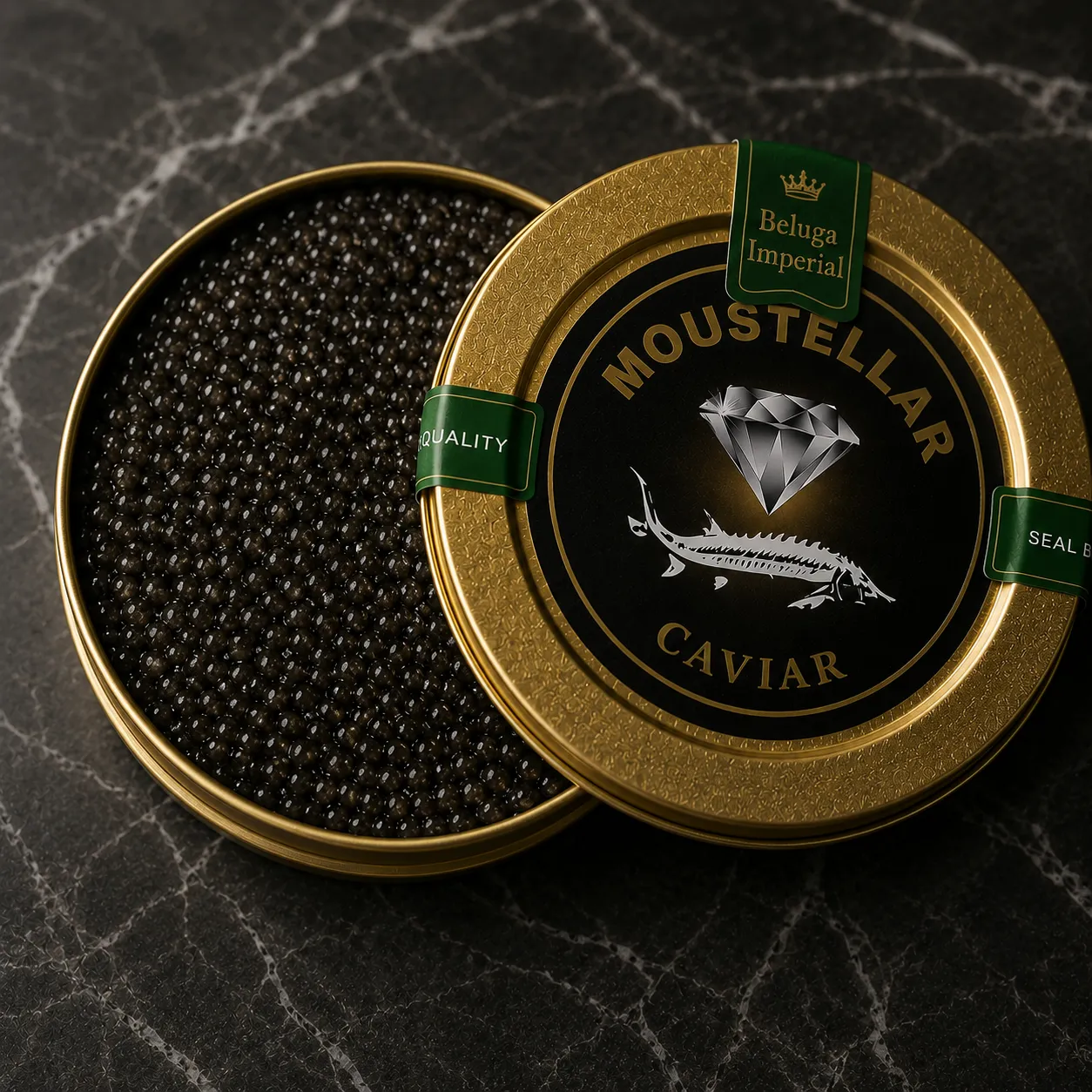
01What Is Beluga Caviar
Beluga caviar is the roe of the Huso huso, the largest sturgeon species on Earth and one of the oldest surviving fish lineages, with ancestors dating back over 200 million years — long before dinosaurs walked the planet. A mature Beluga sturgeon can grow beyond 4 meters in length, weigh over a thousand kilograms, and live for more than a century. Yet it takes an extraordinary 15 to 20 years before a female is sexually mature enough to yield eggs, and even then, she may only be harvested once every few years. This single biological fact — rarity born from patience — is the primary reason Beluga caviar commands the highest price of any caviar in the world, and why the phrase "buy Beluga caviar" so often leads shoppers into a maze of conflicting claims about authenticity and quality.
The pearls themselves are the largest of any caviar variety, typically measuring 3.1mm to 3.3mm in diameter — nearly the size of a small pea — with a color range spanning from deep charcoal and graphite grey to the prized pale Steel Grey that borders on silver. As a general rule, the lighter and more translucent the color, the rarer and more valuable the grade, since paler pearls typically come from older, more mature sturgeon whose eggs have developed a thinner, more delicate membrane.
A Living Fossil With a Modern Story
Sturgeon are often called "living fossils" because their basic body structure has remained largely unchanged since the age of the dinosaurs. The Huso huso specifically evolved in the Caspian and Black Sea basins, migrating between saltwater and the freshwater rivers that feed into them to spawn. This ancient migratory pattern is central to understanding both the flavor of the caviar it produces and the conservation challenges the species has faced in the modern era — a topic we cover in depth in the Origin and CITES sections below.
How Beluga Caviar Is Made
The process of transforming raw roe into the polished, ready-to-eat caviar you see in a tin is a craft refined over centuries. After a female sturgeon reaches maturity and is confirmed to be carrying viable roe (traditionally checked non-lethally today via ultrasound in modern sustainable farms), the eggs are carefully harvested, gently rinsed to remove any fatty tissue or blood, and passed over a fine mesh screen — called a grohot — to separate individual pearls without damaging their delicate membrane.
From there, the roe is lightly salted using the malossol method (Russian for "little salt"), which uses just enough salt — typically under 5% by weight — to preserve the eggs while keeping their natural, buttery flavor intact. The caviar is then hand-graded for color, size, and consistency before being packed into tins under vacuum-sealed, refrigerated conditions to lock in freshness until it reaches your table.
Understanding Beluga Grades
Not every tin labeled "Beluga" is created equal. Within the species itself, caviar is typically separated into grades based on three core criteria: pearl size, color uniformity, and membrane integrity. The highest grades — such as our own Imperial designation — feature the largest, most uniformly pale, Steel Grey pearls with an unblemished, glossy sheen. Lower grades may still be entirely authentic Beluga but with smaller or more inconsistently colored pearls, which is reflected in a lower price point.
Beluga vs. Other Caviar Types
To put Beluga's rarity in context, it helps to compare it against the other sturgeon caviars most commonly available on the market today — including two other varieties in moustellar's own collection, Sevruga Prestige and Osetra Iran, alongside our Royal Baerii Caviar.
| Caviar | Species | Pearl Size | Hue | Flavor Profile |
|---|---|---|---|---|
| Beluga Imperial | Huso huso | 3.1mm – 3.3mm | Steel Grey | Silky and delicate — the rarest pearl of the Caspian |
| Osetra Iran | Acipenser gueldenstaedtii | 2.7mm – 2.9mm | Amber Brown | Nutty and balanced, with a soft buttery finish |
| Sevruga Prestige | Acipenser stellatus | 2.8mm – 3.0mm | Charcoal Grey | Briny, bold, and unapologetic — for lovers of pure sea flavor |
| Royal Baerii Caviar | Huso dauricus | 2.7mm – 2.9mm | Dark Umber | Buttery and generous, with a satisfying pop |
Historically reserved for royalty, tsars, and heads of state, Beluga remains the benchmark against which all other caviars are measured — the reference point every other sturgeon roe is described in relation to. If you're comparing grades before you buy, our Beluga Imperial selection is hand-graded specifically for pearl size, color consistency, and membrane delicacy — the three factors that separate a good tin from an exceptional one.
02Why Iranian Beluga Caviar
Not all Beluga caviar is equal, and origin matters enormously — arguably as much as the species itself. Iran's southern Caspian coastline sits at the confluence of cold, nutrient-rich currents that slow the sturgeon's metabolism and allow eggs to develop a firmer membrane and deeper flavor complexity compared to warmer northern waters found elsewhere along the Caspian basin.
Slower metabolic development isn't a minor detail — it's arguably the single biggest driver of quality difference between regions. Sturgeon raised in colder waters take longer to mature, which in turn allows their eggs more time to develop the size, membrane thickness, and fat content that ultimately determines both the "melt" texture and the buttery flavor connoisseurs seek.
A Century of Heritage
Iran also holds one of the longest continuous caviar-processing traditions in the world — over a century of hand-grading techniques passed down through generations of master graders. Long before industrial caviar farming existed anywhere else, Iranian processing houses along the Caspian coast were refining methods of separating premium grades purely by sight, smell, and touch — skills that machine sorting, even today, struggles to fully replicate.
The Malossol Method Explained
Iranian houses are historically associated with the strictest interpretation of malossol processing — using the absolute minimum salt necessary to preserve the roe while keeping its natural, buttery flavor completely intact. Because malossol caviar has a shorter shelf life than heavily salted alternatives, achieving this balance consistently requires impeccable cold-chain logistics from the moment of harvest — something that historically only the most established Caspian processing houses, largely based in Iran, could reliably guarantee.
- Colder waters: slower egg development produces larger, more uniform pearls with thicker, more resilient membranes.
- Traditional hand-grading: generational expertise in separating premium grades by eye and touch, rather than relying solely on automated sorting.
- Minimal salt processing: preserves natural sweetness rather than masking it with heavy salting.
- Stricter quality control: tighter tolerances for size, color, and membrane integrity than many competing regions.
- Cultural reverence for the craft: caviar production in Iran is treated as an artisanal discipline, not merely an industrial commodity.
This combination of geography and craftsmanship is why connoisseurs, sommeliers, and Michelin-starred kitchens consistently seek out Iranian Beluga when sourcing the finest caviar available — and why origin should be one of the very first questions you ask before you buy Beluga caviar from any supplier.
03Why Buy From moustellar
Sourcing authentic, legally documented Beluga caviar online can be daunting. The market has no shortage of mislabeled products, vague origin claims, and suppliers who cut corners on cold-chain logistics — all of which directly compromise the very qualities that make Beluga worth its price. moustellar was built specifically to remove that uncertainty from the buying experience.
Our Grading Process
Every batch of Beluga Imperial passes through a rigorous, multi-stage hand-grading process before it's approved for sale. Master graders inspect each batch for pearl uniformity (targeting the 3.1mm–3.3mm range), Steel Grey color consistency, and membrane delicacy — rejecting any lot that doesn't meet our internal benchmark for the "Imperial" designation. This is the same layer of scrutiny historically reserved for caviar destined for royal courts, applied consistently to every single tin we ship.
Traceability You Can Verify
Transparency isn't an afterthought for us — it's structural. Every tin we sell carries CITES documentation and clear origin labeling, so you always know exactly what you're purchasing and where it came from. We believe that when you're paying a premium price for a premium product, you deserve complete confidence in its authenticity, not just a marketing claim.
- Hand-graded batches — every tin is individually assessed for size, color, and texture by master graders before it's approved for sale.
- Sustainable, CITES-compliant sourcing — full traceability from controlled aquaculture to your door.
- True cold-chain logistics — insulated, temperature-controlled shipping that guarantees freshness within 72 hours anywhere in the world.
- Direct concierge service — real specialists available via WhatsApp, Telegram, or email for every order, not automated chatbots.
- Flexible sizing — from 30-gram tasting tins to 1-kilogram tins for large events, all priced transparently by weight.
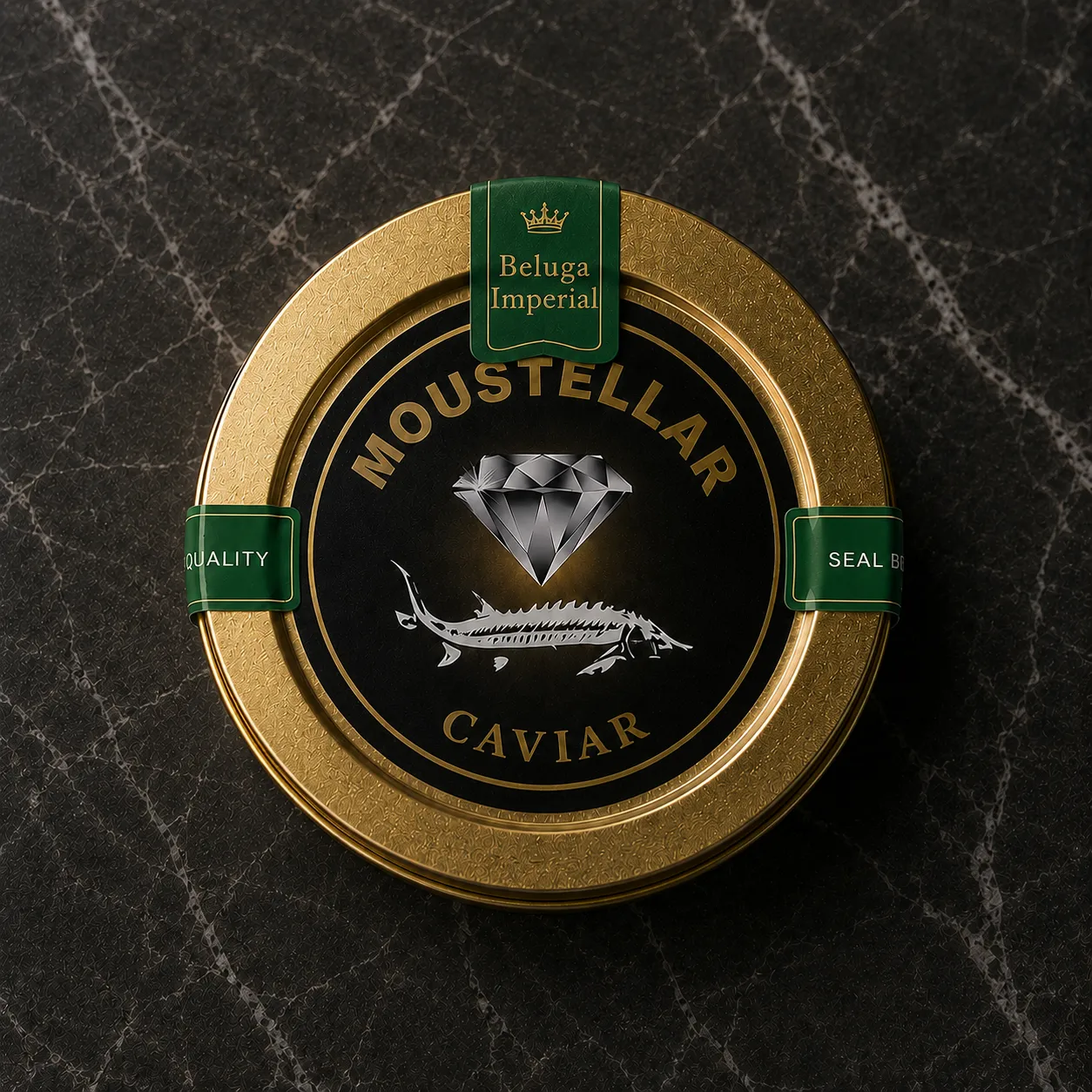
04Taste
The defining trait of great Beluga caviar is restraint. Where smaller-grain caviars like Sevruga Prestige can taste intensely briny and bold, Beluga is famous for its buttery, rich flavor with a clean, mild finish that carries almost no "fishiness" — a hallmark of freshness and proper processing rather than an inherent quality of sturgeon roe in general.
Expect layered notes of sweet cream, gentle ocean minerality, and a faint, pleasant nuttiness that lingers on the palate rather than overwhelming it. This subtlety is precisely why Beluga is traditionally served unadorned — any strong pairing risks masking the very qualities that make it exceptional in the first place.
How Taste Evolves Across Grades
Not all Beluga tastes identical. Younger sturgeon, or fish farmed in warmer, less ideal waters, tend to produce roe with a sharper, more pronounced brininess and less of that signature buttery finish. As pearl color lightens toward the prized Steel Grey end of the spectrum, flavor typically becomes progressively milder, creamier, and more refined — which is part of why lighter grades command higher prices.
Common Misconceptions About Flavor
Many first-time buyers expect caviar to taste overwhelmingly "fishy," largely due to exposure to poorly processed or improperly stored product. Authentic, fresh, high-grade Beluga should never taste sharply fishy or metallic — if it does, that's typically a sign of oxidation, age, or improper handling rather than a characteristic of the caviar itself.
A clean palate is essential. Taste Beluga caviar on its own first, at cellar temperature on the tongue, before adding any accompaniment — this is the only way to appreciate its true flavor arc, from the initial contact through to the lingering finish.
05Texture
Texture is where Beluga truly separates itself from every other caviar. At 3.1mm to 3.3mm, the pearls are the largest available on the market, and their membrane is remarkably thin and delicate — it yields almost instantly on the palate rather than "popping" firmly the way smaller-grain roe like Sevruga Prestige (2.8mm–3.0mm) typically does.
This creates the sensation connoisseurs describe as a "melt" — the egg dissolves into a smooth, creamy finish rather than releasing a sharp burst of brine all at once. It's a fundamentally different eating experience than most people expect from caviar, and it's frequently what converts skeptics into lifelong enthusiasts after their first proper tasting.
The Science Behind the Melt
The "melt" sensation is a function of two biological factors: membrane thickness and fat content. Beluga eggs, particularly from older, fully mature sturgeon, develop a thinner outer membrane relative to their overall size, combined with a higher internal fat content than smaller sturgeon species. Together, these traits cause the egg to rupture and disperse almost immediately under gentle pressure from the tongue, rather than requiring a firm bite to release its interior — hence the buttery, almost liquid quality Beluga is famous for. By comparison, our Royal Baerii Caviar (2.7mm–2.9mm) is prized for the opposite reason: a firmer, more satisfying "pop" that still finishes buttery and generous.
Grading for texture involves assessing membrane thickness, pearl uniformity, and moisture content by touch — which is precisely why hand-grading by an experienced eye and hand remains the gold standard for premium Beluga, rather than relying purely on automated, machine-based sorting systems.
06Origin
All authentic Beluga caviar originates from the Caspian Sea basin — the largest inland body of water on Earth, more than four times the size of the next largest lake globally, bordered by five nations: Iran, Russia, Kazakhstan, Turkmenistan, and Azerbaijan. The Huso huso is anadromous, meaning it historically migrated from the Caspian into connecting rivers such as the Volga and Ural to spawn, a journey that could span hundreds of kilometers upstream.
The Five Caspian Nations
While the Caspian Sea is shared among five countries, caviar quality has never been uniform across the basin. Differences in water temperature, salinity, pollution levels, and — critically — differences in national processing traditions and regulatory rigor, mean that origin within the Caspian matters just as much as being "Caspian" in the first place. This is the core reason Iranian-origin Beluga has maintained its reputation as the benchmark standard, as covered earlier in this guide.
From Wild Catch to Sustainable Aquaculture
Historically, essentially all Beluga caviar came from wild-caught sturgeon intercepted during their spawning migrations. Today, that landscape has changed entirely. Wild Beluga sturgeon populations declined sharply through the 20th century due to a combination of overfishing, industrial pollution, and habitat disruption caused by damming of the rivers sturgeon relied on to spawn — a decline severe enough to trigger international conservation intervention, which we detail in the next section.
In response, the industry pivoted decisively toward controlled aquaculture: land-based and coastal farming operations that replicate the temperature, water chemistry, and migratory conditions sturgeon need to thrive and mature naturally, without depleting wild populations. Virtually all commercially available Beluga caviar today — including everything sold by reputable, CITES-compliant suppliers — comes from this kind of sustainable aquaculture rather than wild capture.
07CITES & Legality
Because wild sturgeon populations were pushed to the brink of collapse, the Huso huso is listed under CITES Appendix II — the Convention on International Trade in Endangered Species of Wild Fauna and Flora, an international agreement between over 180 countries designed to ensure that trade in listed species doesn't threaten their survival.
Appendix II listing doesn't ban caviar trade outright; rather, it regulates it. Every legal shipment must carry a valid CITES export permit, and every tin must bear a uniquely numbered label that allows the product to be traced back to its source facility, production date, and country of origin. This traceability system exists precisely so that legitimate, sustainably farmed caviar can continue reaching global markets while illegal, unregulated wild harvesting is cut off from legal trade channels.
How to Verify Authenticity Before You Buy
Before you buy Beluga caviar from any supplier, there are a few concrete checks you can perform to confirm legitimacy:
- Check the tin label — it should display a CITES registration number, the species name (Huso huso), country of origin, and a production or "best before" date.
- Ask for documentation — a reputable supplier will readily provide CITES export paperwork upon request, without hesitation or vague answers.
- Verify the source facility — legitimate suppliers can name and, where possible, describe their sourcing farm or facility in detail.
- Be wary of "wild-caught" claims — since wild Beluga trade is effectively restricted to protect the species, any product marketed primarily as "wild-caught" should raise immediate red flags.
Common Import Mistakes to Avoid
Many first-time international buyers unknowingly run into legal trouble not because they intended to purchase illegal product, but because they were unaware of import limits and documentation requirements in their own country. Most nations impose personal import limits on caviar (commonly around 125 grams per traveler without additional permits) and require the CITES tag to remain attached and legible. Reputable online sellers who ship internationally, like moustellar, structure their logistics and documentation specifically to keep buyers compliant automatically.
Never purchase caviar without visible CITES labeling or documented origin. Unregistered "wild" caviar sold online is very often mislabeled, illegally sourced, or simply inauthentic — and importing it can carry legal consequences, including confiscation at customs.
Every batch sold by moustellar is fully CITES-compliant, sustainably farmed, and accompanied by documentation confirming legal origin — so you can buy Beluga caviar online with complete confidence in its authenticity and legality, wherever in the world you're located.
08Shipping
Fresh caviar is a living, perishable product, and shipping is one of the most overlooked factors in overall quality when buyers compare suppliers online. Once a tin leaves cold storage, every hour of exposure to warmer temperatures degrades texture and flavor — which is why logistics matter almost as much as sourcing itself.
Cold-Sealed Packing
Each tin is packed in an insulated, temperature-controlled case alongside medical-grade ice packs immediately before dispatch, minimizing the time between cold storage and transit.
Continuous Cold Chain
The shipment maintains 0°C to 4°C throughout transit via express courier partners — no ambient handling gaps or unnecessary warehouse stops that could compromise temperature.
72-Hour Global Delivery
Orders arrive within 72 hours virtually anywhere in the world, still perfectly chilled and ready to serve straight from the box.
International Shipping Considerations
When ordering Beluga caviar across international borders, it's worth confirming three things with your supplier in advance: whether CITES documentation will be included with the shipment, whether the courier has experience with perishable, temperature-sensitive goods, and whether any customs duties or import limits apply in your destination country. A trustworthy supplier will proactively walk you through all three rather than leaving you to discover complications after the order has shipped.
09Storage
Once your caviar arrives, proper storage determines how well it holds its texture and flavor over the following days — and mishandling at this stage is one of the most common reasons buyers feel disappointed by an otherwise excellent product.
| Condition | Ideal Temperature | Timeframe |
|---|---|---|
| Unopened tin | 0°C to -4°C | Up to production "best before" date |
| Opened tin | 0°C to 4°C, tightly resealed | Consume within 48 hours |
| Room temperature exposure | Above 4°C | Avoid entirely; serve promptly once removed from cold storage |
- Unopened tins: store at 0°C to -4°C, ideally in the coldest drawer of your refrigerator, lying flat to keep the roe evenly distributed against the lid.
- Opened tins: consume within 48 hours for peak freshness; always reseal tightly between servings to limit air exposure.
- Utensils: use only mother-of-pearl, glass, bone, or wood spoons — metal reacts with the roe and distorts its delicate flavor, introducing a metallic taste that masks the caviar's natural profile.
- Avoid freezing: freezing ruptures the delicate membrane and destroys the signature "melt" texture, turning firm, distinct pearls into a mushy, less appealing consistency upon thawing.
- Keep away from strong odors: caviar can absorb surrounding smells in the refrigerator, so store it away from strongly scented foods like onions or aged cheese.
10Serving Guide
Beluga caviar is best served simply, at a chilled temperature (0°C to 4°C), directly from the tin nestled on a bed of crushed ice to maintain temperature throughout service.
A Step-by-Step Tasting Ritual
- Remove the tin from the refrigerator no more than 10–15 minutes before serving.
- Nestle the opened tin into a bowl of crushed ice to maintain a consistent chilled temperature.
- Using a non-metallic spoon, take a small portion directly onto the back of your hand (a classic tasting technique that avoids the interference of other flavors) or onto a blini.
- Let the pearls rest on your tongue for a moment before gently pressing them against the roof of your mouth to release their flavor.
- Pause between bites to notice how the flavor evolves from the initial buttery note to the clean, mineral finish.
Recommended Accompaniments
- Warm, unsalted blini or lightly toasted brioche points
- A light dab of crème fraîche (optional, and best reserved for lighter, milder grades)
- Chilled vodka or dry, mineral-driven Champagne
Pairing With Beverages
| Beverage | Why It Works |
|---|---|
| Chilled Vodka | Neutral, clean palate cleanser that doesn't compete with delicate flavors |
| Brut Champagne | High acidity and fine bubbles complement the caviar's richness |
| Dry Riesling | Mineral, low-sugar profile pairs well without overpowering |
What to Avoid
- Strong or acidic garnishes like onion, lemon, or capers — these overpower Beluga's subtlety and mask the very qualities you're paying a premium for
- Metal spoons or serving utensils
- Serving at room temperature or leaving the tin out for extended periods
As a general rule, plan for 20–30 grams per person for a tasting portion as part of a broader meal, or 50 grams per person when caviar is the centerpiece of a dedicated course or celebration. You can view exact tin sizes and transparent pricing on our Beluga Imperial page, available from 30g up to 1kg to suit everything from an intimate tasting to a large event.
11Frequently Asked Questions
Is it legal to buy Beluga caviar?
What does Beluga caviar taste like?
How much does Beluga caviar cost?
Why is Iranian Beluga caviar considered the best?
How should I store Beluga caviar?
Is farmed Beluga caviar as good as wild?
Where can I buy authentic Beluga caviar online?
How can I tell if Beluga caviar is fresh?
What is the difference between Beluga and Osetra caviar?
How much Beluga caviar should I serve per person?
Ready to Buy Beluga Caviar?
Beluga Imperial is hand-graded from mature Huso huso sturgeon, fully CITES-documented, and delivered fresh to your door in 72 hours — anywhere in the world.
Shop Beluga Imperial