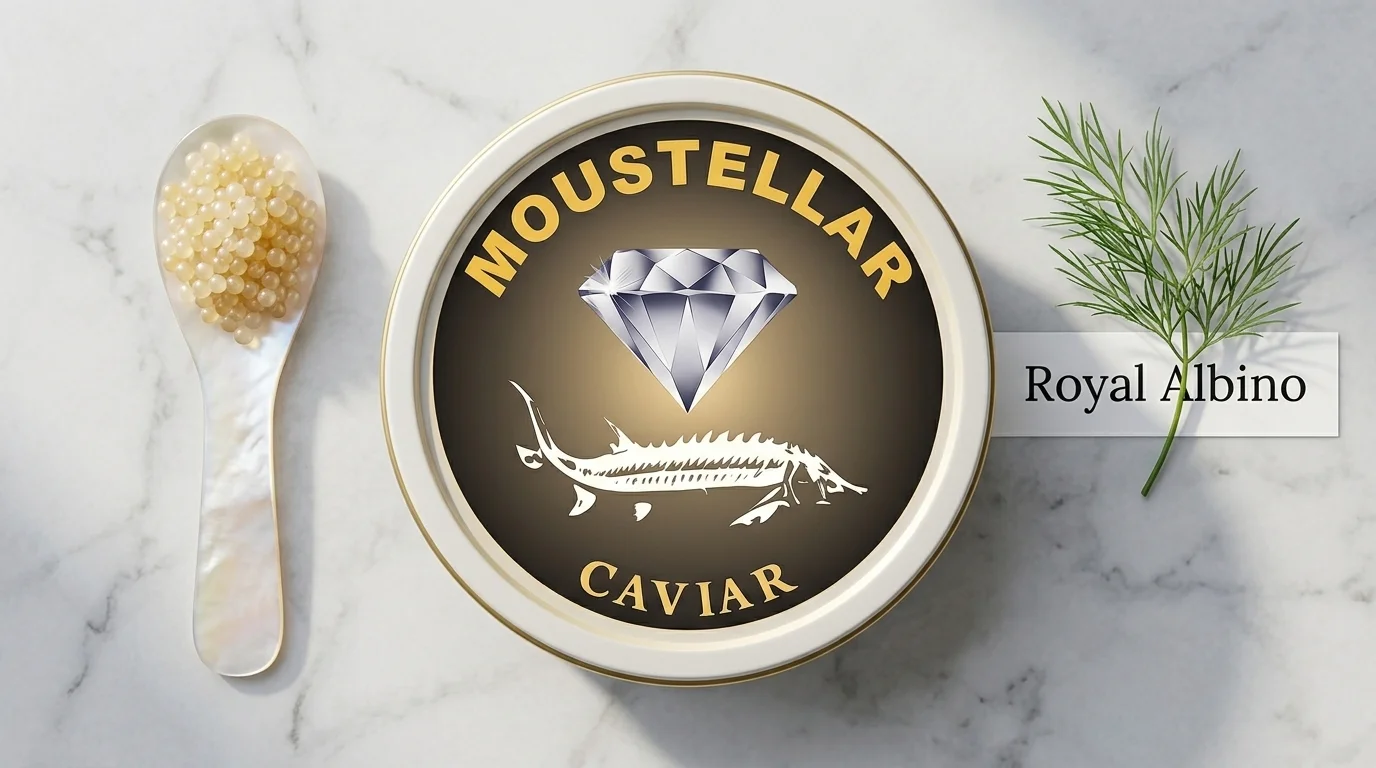
01What Is Royal Albino Caviar
Royal Albino caviar is the roe of an albino sturgeon - most commonly the albino sterlet, Acipenser ruthenus, though exceptional albino examples of other sturgeon species also exist. Its defining characteristic is not a species in the traditional sense but a rare genetic condition: a recessive lack of melanin that leaves the fish pale and, more importantly, produces caviar pearls of an extraordinary white-gold to canary-yellow hue. It is one of the rarest caviars on the market, representing well under 1% of the annual global harvest.
The sterlet is the smallest of the classic sturgeons, and females typically reach maturity in roughly 6 to 8 years. That would already make the roe relatively accessible - but the albino mutation is so uncommon that only a handful of fish from any generation develop the pale coloration and egg quality required for true Royal Albino grading. The result is a caviar that combines the sterlet's naturally refined, small pearl with an almost mythical visual presence.
The beads are small and luminous, measuring 1.8mm to 2.1mm, with a colour spectrum running from pale cream and butter to the most prized expression: a clear, even white-gold or canary yellow with a glassy, pearl-like sheen. Unlike darker caviars, where colour depth signals intensity, Royal Albino is judged on clarity, luminosity and uniformity - any dullness, brown tinge or clumping is immediately disqualifying.
The Caviar of the Collector
Royal Albino has always occupied a place apart from the everyday caviars. It was never the working caviar of fishermen's breakfasts or the neutral garnish of hotel canapés. Because of its scarcity, it has historically been reserved for special occasions, gifts and the tables of collectors who value distinction as much as flavour. A tin opened at a dinner does not simply feed guests; it becomes the conversation.
That reputation explains why Royal Albino is often chosen by people who already know Sevruga, Osetra and Beluga intimately and are looking for something beyond the classic hierarchy. It does not replace the other great caviars; it completes them.
How Royal Albino Caviar Is Made
Producing Royal Albino caviar begins with the careful selection of albino broodstock in controlled European aquaculture facilities. Because albinism is recessive, farms maintain dedicated albino bloodlines, monitoring each generation for the pale pigmentation, health and egg quality that justify the Royal Albino name. Once a female is confirmed to be carrying viable roe - checked by ultrasound in modern sustainable farms - the eggs are harvested, gently rinsed and passed over a fine mesh screen to separate the individual beads without tearing their delicate membrane.
Because Royal Albino beads are exceptionally small and lightly pigmented, graders work under controlled light, looking for uniform colour, intact membranes and a luminous surface. The roe is then lightly salted using the malossol method - Russian for "little salt" - typically under 5% by weight. The goal is to preserve the eggs while leaving the delicate, buttery character of Royal Albino completely unobscured. Heavy salting would overwhelm the subtle flavour that makes the caviar remarkable.
Understanding Royal Albino Grades
Within Royal Albino, caviar is separated into grades on three criteria: colour purity, bead uniformity and membrane integrity. Top grades show evenly sized 1.8mm to 2.1mm beads, a consistent white-gold to canary-yellow tone across the entire tin, distinct separation between pearls and a delicate membrane that yields cleanly without clumping.
Lower grades may still be authentic albino caviar but show mixed bead sizes, uneven colour with darker or creamier outliers, or a softer membrane. Because the visual impact is central to Royal Albino's appeal, these differences are even more pronounced than in darker varieties - and a transparent supplier will describe exactly which grade you are buying.
Royal Albino vs. Other Caviar Types
To place Royal Albino's character in context, it helps to compare it against the other sturgeon caviars most commonly available today - including the three other varieties in moustellar's own collection: Osetra Iran, Sevruga Prestige, and Beluga Imperial.
| Caviar | Species | Pearl Size | Hue | Flavor Profile |
|---|---|---|---|---|
| Royal Albino Caviar | Acipenser ruthenus (albino) | 1.8mm - 2.1mm | White-Gold to Canary Yellow | Delicate, buttery, subtly briny - luminous and rare |
| Osetra Iran | Acipenser gueldenstaedtii | 2.7mm - 2.9mm | Golden Amber | Amber, nutty, and endlessly balanced |
| Sevruga Prestige | Acipenser stellatus | 2.8mm - 3.0mm | Charcoal Grey | Briny, bold, and unapologetic - for lovers of pure sea flavour |
| Beluga Imperial | Huso huso | 3.1mm - 3.3mm | Steel Grey | Silky and delicate - the rarest pearl of the Caspian |
If Sevruga is the most expressive caviar and Osetra the most balanced, Royal Albino is the most visually and texturally refined - the variety chosen when the occasion calls for something extraordinary. If you are comparing grades before you buy, our Royal Albino Caviar selection is hand-graded specifically for colour purity, bead uniformity and membrane integrity - the three factors that separate an interesting tin from an unforgettable one.
02Why Royal Albino
The value of Royal Albino caviar rests on a single word: rarity. It is not produced by choosing a different feed or farming technique; it is produced by the unpredictable appearance of a recessive genetic trait in a sturgeon species already prized for its roe. Every tin is effectively a limited edition, and serious buyers understand that the price reflects scarcity as much as taste.
But rarity alone is not enough. The albino fish must also grow to maturity in conditions that preserve the delicacy of its roe - clean, cool water, a controlled diet and low-stress handling. The finest Royal Albino caviar comes from European aquaculture farms that have spent years developing albino bloodlines and perfecting the gentle processing required for such fragile, pale pearls.
The Genetics of Rarity
Albinism in sturgeon is a recessive trait, meaning both parents must carry the gene for offspring to express it. Even then, only a fraction of fry will be true albinos, and not every albino female will produce roe of the colour, size and quality required for Royal Albino grading. Farms therefore maintain carefully selected albino broodstock over multiple generations, discarding fish that do not meet the visual and flavour standards.
This selection process is slow and expensive, which is why authentic Royal Albino caviar commands a premium. It cannot be scaled quickly, and attempts to imitate the colour through processing or dye are easily detected by experienced graders and are not legal under CITES labelling rules.
Why European Aquaculture Matters
Modern Royal Albino production is centred in Belgium, Italy and a handful of other European countries with advanced sturgeon aquaculture. These farms operate under strict environmental and animal-welfare standards, with water chemistry, temperature and diet monitored continuously. For a delicate caviar like Royal Albino, this control is essential: stress or poor water quality dulls both colour and flavour, and there is no dark pigment to hide imperfections behind.
European farms also pioneered the no-kill and low-kill harvesting techniques now associated with premium albino caviar, allowing valuable albino females to contribute across multiple seasons. This sustainability is not a marketing addition - it is the only way to maintain the bloodlines that produce Royal Albino at all.
- Recessive genetics: true albinism cannot be manufactured; only a small fraction of sturgeon carry and express the trait.
- Strict broodstock selection: farms maintain multi-generational albino bloodlines and cull fish that do not meet colour or quality standards.
- Controlled environment: clean, cool, stable water preserves the delicate membrane and pale colour that define the variety.
- Low-stress handling: gentler farming and harvesting produce roe with the subtle, buttery character Royal Albino is prized for.
- Transparent origin: legitimate Royal Albino is traceable to a specific European farm and carries full CITES documentation.
- Sustainable bloodlines: no-kill and low-kill practices protect the rare albino genetics required for future harvests.
This combination of genetics and craftsmanship is why connoisseurs and collectors consistently seek out Royal Albino Caviar from reputable European farms - and why origin and documentation should be the first things you verify before you buy.
03Why Buy From moustellar
Sourcing authentic Royal Albino caviar online requires even more care than darker varieties, because its rarity and high price make it a target for mislabelling and substitution. Vague origin claims, missing CITES paperwork and broken cold chains all compromise the very qualities that justify the cost. moustellar was built to remove that uncertainty from the buying experience.
Our Grading Process
Every batch of Royal Albino Caviar passes through a rigorous, multi-stage hand-grading process before it is approved for sale. Master graders inspect each batch for bead uniformity (targeting the 1.8mm to 2.1mm range), white-gold to canary-yellow colour consistency across the entire tin, and membrane integrity - rejecting any lot with mixed sizing, dullness, clumping or off-tone outliers. Because the visual standard is so central to Royal Albino, this stage is more selective than it is for darker varieties.
Traceability You Can Verify
Transparency is not an afterthought for us - it is structural. Every tin we sell carries CITES documentation and clear origin labelling, so you always know exactly what you are purchasing and where it came from. When you are paying a premium price for a rare product, you deserve complete confidence in its authenticity, not just a marketing claim.
- Hand-graded batches - every tin is individually assessed for bead size, colour purity and texture by master graders before approval.
- Verified species and origin - confirmed albino Acipenser ruthenus from Belgian/European sustainable aquaculture, never a substituted or dyed roe sold under the Royal Albino name.
- Sustainable, CITES-compliant sourcing - full traceability from controlled aquaculture to your door.
- True cold-chain logistics - insulated, temperature-controlled shipping that guarantees freshness within 72 hours anywhere in the world.
- Custom weight ordering - order exactly the quantity you need, from an intimate tasting portion to a large event, priced transparently by weight.
- Direct concierge service - real specialists available via WhatsApp, Telegram or email for every order, not automated chatbots.
04Taste
The defining trait of great Royal Albino caviar is delicacy with depth. Where Sevruga is bold and Osetra is nutty, Royal Albino occupies the most refined end of the spectrum: a gentle, creamy flavour that reveals itself slowly, supported by a soft brine rather than driven by it.
The first impression is a whisper of clean, oceanic brine, far subtler than any classic Caspian variety. Beneath it sits a distinctly buttery, almost brioche-like core - the signature of well-farmed albino sterlet - followed by faint notes of kefir, cream and noble woods that arrive late and linger elegantly. The finish is smooth and short, leaving the palate clean rather than coated. That restraint is exactly why Royal Albino is best appreciated with minimal accompaniments, and why even a small portion feels generous.
How Taste Evolves Across Grades
Not all Royal Albino tastes identical. Roe from fish raised under stress, or processed with too much salt, tends toward flat, one-dimensional butteriness - pleasant but forgettable. As colour purity and bead uniformity improve toward top grade, the brine becomes more precise, the creamy core more complex, and the finish noticeably cleaner. With Royal Albino, the visual grade is a reliable indicator of flavour refinement.
Common Misconceptions About Flavour
Because Royal Albino is pale and delicate, some buyers assume it will be bland or merely decorative. A well-made tin is neither. Authentic, fresh, high-grade Royal Albino has a clear, defined flavour - it simply expresses itself quietly. Flatness, a sour note or any ammonia aroma signals poor handling or age, never the variety itself.
A second misconception is that Royal Albino is "just white Osetra". While albino Osetra does exist, classic Royal Albino is most commonly produced from albino sterlet (Acipenser ruthenus), a different species with a smaller bead, softer texture and more delicate flavour profile. Always verify the species on the label before buying.
Taste Royal Albino entirely on its own first, at cellar temperature, using a mother-of-pearl spoon. Its flavour is subtle enough that strong accompaniments - lemon, onion, capers - will overwhelm the very notes you are paying to experience.
05Texture
Texture is where Royal Albino offers something genuinely distinct from its larger, darker cousins. At 1.8mm to 2.1mm the beads are small and delicate, with a thin, tender membrane that yields with a soft, refined burst rather than the crisp snap of Sevruga or the firmer pop of Osetra.
Because the beads are so small, you experience many of them at once, creating a silky, almost velvety sensation across the palate. Enthusiasts often describe it as the most graceful of the classic caviars: a gentle cascade of tiny releases that coat the tongue in creamy brine and then dissolve. It is a quieter, more intimate eating experience - and for collectors, precisely what makes Royal Albino feel like a special occasion in every spoonful.
The Science Behind the Delicate Burst
The tender burst is a function of the sterlet's small egg size and proportionally thin outer membrane. Relative to larger species, albino sterlet eggs have less structural resistance and a higher delicate-fat content, so they rupture easily under gentle pressure and release their flavour almost instantly. This is fundamentally different from Sevruga's crisp snap or Beluga's slow melt, and it is why Royal Albino reads as silky where the others read as assertive or creamy.
It is also why Royal Albino is the most fragile variety to handle. A damaged or over-salted membrane collapses without any release, and once beads clump they cannot be recovered. Grading for texture involves assessing membrane tenderness and bead separation by touch - and at this bead size, an experienced hand remains essential.
06Origin
Authentic Royal Albino caviar originates from controlled European aquaculture - most notably in Belgium, with additional high-quality production in Italy and a small number of other specialised farms. The sterlet (Acipenser ruthenus) is native to the rivers and basins of Europe and western Asia, including the Danube, Volga, Dnieper and Ural systems, and was once common across much of the continent.
Unlike the great Caspian caviars, Royal Albino is not tied to a single sea but to a network of advanced farms that have selectively bred albino bloodlines over many years. The best producers combine generations of sturgeon-farming expertise with the patience required to maintain a genetically rare strain.
The Belgian Heritage
Belgium has become particularly associated with high-quality Royal Albino caviar thanks to pioneering farms that focused early on albino sterlet breeding and gentle, low-salt processing. Belgian producers helped establish the visual and flavour benchmarks now expected of the category: pale, uniform pearls, a clean buttery taste and a silky texture. When buyers refer to "Belgian white caviar" they are usually describing the same Royal Albino tradition.
From Wild Rivers to Sustainable Farms
Historically, sterlet were caught in European rivers during spawning migrations, and any albino specimens were extraordinary rarities reserved for the tables of nobility. Today, wild sterlet populations are protected and wild caviar trade is heavily restricted, so all legitimate Royal Albino caviar comes from sustainable aquaculture.
Modern farms replicate the cool, clean, well-oxygenated water conditions sterlet prefer, while controlling diet and stress to produce roe of exceptional colour and flavour. Because sterlet mature faster than many sturgeon species, farming them is commercially viable, but the albino trait remains scarce enough that every harvest feels like a discovery.
07CITES & Legality
Because wild sturgeon populations were pushed to the brink of collapse, the sterlet (Acipenser ruthenus) - like all sturgeon species - is listed under CITES Appendix II, the Convention on International Trade in Endangered Species of Wild Fauna and Flora, an international agreement between more than 180 countries designed to ensure that trade in listed species does not threaten their survival.
Appendix II listing does not ban caviar trade outright; it regulates it. Every legal shipment must carry a valid CITES export permit, and every tin must bear a uniquely numbered label that traces the product back to its source facility, production date and country of origin. This traceability system exists precisely so that legitimate, sustainably farmed caviar can continue reaching global markets while illegal, unregulated wild harvesting is cut off from legal trade channels.
How to Verify Authenticity Before You Buy
Before you buy Royal Albino caviar from any supplier, there are concrete checks you can perform to confirm legitimacy:
- Check the tin label - it should display a CITES registration number, the species name (Acipenser ruthenus), country of origin, and a production or best-before date.
- Confirm the species explicitly - Royal Albino is most commonly albino sterlet, not a generic "white caviar". A legitimate supplier states Acipenser ruthenus in writing.
- Ask for documentation - a reputable supplier will readily provide CITES export paperwork on request, without hesitation or vague answers.
- Verify the source facility - legitimate suppliers can name and describe their sourcing farm or facility in detail.
- Be wary of wild-caught claims - since wild sturgeon trade is effectively restricted to protect the species, any product marketed primarily as wild-caught should raise immediate red flags.
- Beware of impossibly low prices - genuine Royal Albino requires rare albino broodstock and years of careful farming; prices far below market rate almost always indicate mislabelled, dyed or counterfeit product.
Common Import Mistakes to Avoid
Many first-time international buyers run into legal trouble not because they intended to purchase illegal product, but because they were unaware of import limits and documentation requirements in their own country. Most nations impose personal import limits on caviar - commonly around 125 grams per traveller without additional permits - and require the CITES tag to remain attached and legible. Reputable online sellers who ship internationally, like moustellar, structure their logistics and documentation specifically to keep buyers compliant automatically.
Never purchase caviar without visible CITES labelling or documented origin. Unregistered "wild" caviar sold online is very often mislabelled, illegally sourced or simply inauthentic - and importing it can carry legal consequences, including confiscation at customs.
Every batch sold by moustellar is fully CITES-compliant, sustainably farmed and accompanied by documentation confirming legal origin - so you can buy Royal Albino caviar online with complete confidence in its authenticity and legality, wherever in the world you are located.
08Shipping
Fresh caviar is a living, perishable product, and shipping is one of the most overlooked factors in overall quality when buyers compare suppliers online. Once a tin leaves cold storage, every hour of exposure to warmer temperatures degrades texture and flavour - and Royal Albino shows that degradation faster than most, because its delicate membranes soften quickly and the tender burst is the first thing to disappear. With this variety, logistics matter almost as much as sourcing.
Cold-Sealed Packing
Each tin is packed in an insulated, temperature-controlled case alongside medical-grade ice packs immediately before dispatch, minimising the time between cold storage and transit.
Continuous Cold Chain
The shipment maintains 0°C to 4°C throughout transit via express courier partners - no ambient handling gaps or unnecessary warehouse stops that could compromise temperature.
72-Hour Global Delivery
Orders arrive within 72 hours virtually anywhere in the world, still perfectly chilled and ready to serve straight from the box.
International Shipping Considerations
When ordering Royal Albino caviar across international borders, confirm three things with your supplier in advance: whether CITES documentation will be included with the shipment, whether the courier has genuine experience with perishable temperature-sensitive goods, and whether any customs duties or personal import limits apply in your destination country. A trustworthy supplier will proactively walk you through all three rather than leaving you to discover complications after the order has shipped.
09Storage
Once your caviar arrives, proper storage determines how well it holds its texture and flavour over the following days - and mishandling at this stage is one of the most common reasons buyers feel disappointed by an otherwise excellent product. For Royal Albino specifically, the risk is textural and visual: warmth softens the delicate membranes and dulls the luminous colour, while air exposure causes the beads to clump.
| Condition | Ideal Temperature | Timeframe |
|---|---|---|
| Unopened tin | 0°C to -4°C | Up to production best-before date |
| Opened tin | 0°C to 4°C, tightly resealed | Consume within 48 hours |
| Room temperature exposure | Above 4°C | Avoid entirely; serve promptly once removed from cold storage |
- Unopened tins: store at 0°C to -4°C, ideally in the coldest drawer of your refrigerator, lying flat to keep the roe evenly distributed against the lid.
- Opened tins: consume within 48 hours for peak freshness; always reseal tightly between servings to limit air exposure.
- Utensils: use only mother-of-pearl, glass, bone or wood spoons - metal reacts with the roe and introduces a metallic taste, which is especially destructive to Royal Albino's delicate flavour.
- Avoid freezing: freezing ruptures the membrane and destroys the tender burst, turning delicate pearls mushy on thawing. Royal Albino suffers this more visibly than larger varieties.
- Keep away from strong odours: caviar readily absorbs surrounding smells, so store it away from strongly scented foods such as onions or aged cheese.
10Serving Guide
Royal Albino caviar is best served chilled (0°C to 4°C), directly from the tin nestled on a bed of crushed ice to maintain temperature throughout service. Thanks to its delicate, buttery character, Royal Albino is the least adorned of the great caviars - assertive enough to command attention, yet subtle enough to be flattened by strong garnishes. Serve it simply.
A Step-by-Step Tasting Ritual
- Remove the tin from the refrigerator no more than 10 to 15 minutes before serving.
- Nestle the opened tin into a bowl of crushed ice to maintain a consistent chilled temperature.
- Using a non-metallic spoon, take a small portion directly onto the back of your hand - a classic tasting technique that avoids the interference of other flavours - or onto a blini.
- Let the beads rest on your tongue for a moment before gently pressing them against the roof of your mouth to release the delicate, silky burst.
- Pause between bites to notice how the flavour moves from the soft brine through the buttery core to the clean, elegant finish.
Recommended Accompaniments
- Warm, unsalted blini with the lightest touch of crème fraîche - enough texture, not too much cream
- Plain warm boiled new potato with a whisper of butter - a neutral canvas that lets the colour and flavour shine
- Thin, barely buttered toast points or water crackers
- Ice-cold vodka or a very fine, aged Champagne with restrained dosage
Pairing With Beverages
| Beverage | Why It Works |
|---|---|
| Prestige Champagne | Fine, persistent bubbles and restrained dosage complement the caviar's delicate creaminess without masking it |
| Ice-Cold Vodka | A neutral, freezing spirit resets the palate between bites and lets the subtle flavour come through |
| White Burgundy | Chardonnay with elegant oak and minerality mirrors the buttery, refined texture of Royal Albino |
| Blanc de Blancs | Chalky, citrus-edged and lean - a classic pairing for pale, delicate caviar |
What to Avoid
- Strong or acidic garnishes such as raw onion, lemon, capers or chopped egg - these will instantly overwhelm Royal Albino's subtle flavour
- Metal spoons or serving utensils
- Heavily oaked or high-alcohol wines, which clash with delicate caviar
- Serving at room temperature or leaving the tin out for extended periods
As a general rule, plan for 20 to 30 grams per person for a tasting portion as part of a broader meal, or 50 grams per person when caviar is the centrepiece of a dedicated course or celebration. Because Royal Albino is so delicate and rich, many hosts serve slightly smaller portions with minimal accompaniments. You can order the exact quantity you need on our Royal Albino Caviar page, available in custom weights to suit everything from an intimate tasting to a large event.
11Frequently Asked Questions
Is it legal to buy Royal Albino caviar?
What does Royal Albino caviar taste like?
How much does Royal Albino caviar cost?
Why is Royal Albino caviar so rare?
How should I store Royal Albino caviar?
Is farmed Royal Albino caviar as good as wild?
Where can I buy authentic Royal Albino caviar online?
How can I tell if Royal Albino caviar is fresh?
What is the difference between Royal Albino and Osetra caviar?
How much Royal Albino caviar should I serve per person?
Ready to Buy Royal Albino Caviar?
Royal Albino Caviar is hand-graded from Belgian Acipenser ruthenus, fully CITES-documented, available in custom weights and delivered fresh to your door in 72 hours - anywhere in the world.
Shop Royal Albino Caviar