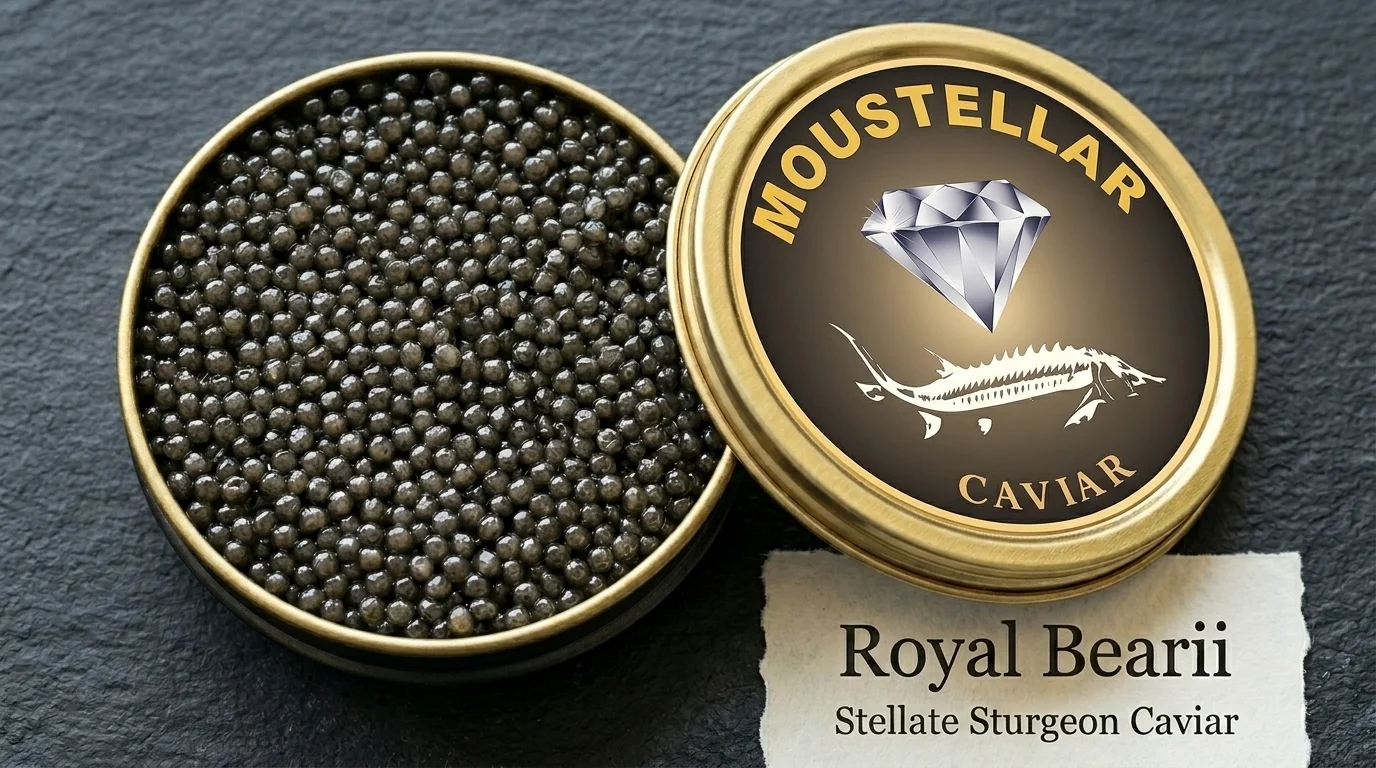
01What Is Royal Baerii Caviar
Royal Baerii caviar is the roe of the Huso dauricus — the Kaluga sturgeon — a fish of genuine legend. It is the closest living relative of the great Beluga (Huso huso) and the only other member of the Huso genus, which is why connoisseurs and chefs have long nicknamed it the "River Beluga." Like its famous cousin, the Kaluga is a giant: historically it could grow beyond five meters in length and weigh over a thousand kilograms, ranking it among the largest freshwater fish on Earth. Its lineage, like all sturgeon, stretches back over 200 million years.
Where the Kaluga sturgeon differs most meaningfully from Beluga is time. Females reach maturity in 8 to 10 years — roughly half the 15 to 20 years a Beluga requires. That single biological fact is the reason Royal Baerii delivers genuine large-pearl, buttery sturgeon caviar at a far more accessible price, and why the phrase "buy Baerii caviar" has quietly become the smart entry point into fine caviar for everyone from first-time buyers to Michelin-starred event chefs.
The pearls themselves are impressively large, typically measuring 2.7mm to 2.9mm in diameter, with a color spectrum ranging from deep charcoal-brown to the prized Dark Umber — a warm, glossy, almost bronze-tinged darkness with a distinctive translucence when held to the light.
The Emperor's Fish
The Kaluga sturgeon carries a royal pedigree that rivals any caviar in history. Native to the Amur River basin along the border of Russia and China, the fish was for centuries considered so valuable that it was sent as tribute to the emperors of China, while its roe graced the tables of the Russian imperial court alongside Beluga itself. A sturgeon that literally belonged to emperors — that is the heritage behind every tin of Royal Baerii, and the reason the "Royal" designation is more than marketing.
How Royal Baerii Caviar Is Made
The process of transforming raw roe into finished caviar follows the same centuries-old craft as the great Caspian varieties. After a female sturgeon reaches maturity and is confirmed to be carrying viable roe (checked non-lethally via ultrasound in modern sustainable farms), the eggs are carefully harvested, gently rinsed, and passed over a fine mesh screen — called a grohot — to separate individual pearls without damaging their firm, glossy membrane.
From there, the roe is lightly salted using the malossol method (Russian for "little salt"), which uses just enough salt — typically under 5% by weight — to preserve the eggs while keeping their natural, buttery richness completely intact. The caviar is then hand-graded for size, color, and consistency before being packed into tins under vacuum-sealed, refrigerated conditions to lock in freshness until it reaches your table.
Understanding Baerii Grades
Not every tin labeled "Baerii" or "Kaluga" is created equal. Within the species, caviar is separated into grades based on three core criteria: pearl size, color uniformity, and membrane integrity. The highest grades — such as our own Royal designation — feature the largest, most uniformly dark umber pearls with a firm, unblemished membrane and a glossy sheen. Lower grades may still be authentic Baerii but with smaller or less consistently colored pearls, which is reflected in a lower price point.
Royal Baerii vs. Other Caviar Types
To put Royal Baerii's character in context, it helps to compare it against the other sturgeon caviars most commonly available on the market today — including three other varieties in moustellar's own collection, Beluga Imperial, Osetra Iran, and Sevruga Prestige.
| Caviar | Species | Pearl Size | Hue | Flavor Profile |
|---|---|---|---|---|
| Royal Baerii | Huso dauricus | 2.7mm – 2.9mm | Dark Umber | Buttery and generous, with a satisfying pop |
| Beluga Imperial | Huso huso | 3.1mm – 3.3mm | Steel Grey | Silky and delicate — the rarest pearl of the Caspian |
| Osetra Iran | Acipenser gueldenstaedtii | 2.7mm – 2.9mm | Golden Amber | Amber, nutty, and endlessly balanced |
| Sevruga Prestige | Acipenser stellatus | 2.8mm – 3.0mm | Charcoal Grey | Briny, bold, and unapologetic — for lovers of pure sea flavor |
If Beluga is the rarest caviar and Osetra the most balanced, Royal Baerii is the most generous — big pearls, bold butteriness, and a texture that performs beautifully at both intimate tastings and grand events. If you're comparing grades before you buy, our Royal Baerii selection is hand-graded specifically for pearl size, dark umber color consistency, and membrane integrity — the three factors that separate a good tin from an exceptional one.
02Why Royal Baerii Caviar
Among the world's great caviars, Royal Baerii occupies a position no other variety can claim: it is the closest experience to Beluga — the same Huso genus, the same giant-sturgeon heritage, the same buttery depth — at a fraction of the price. For many chefs and connoisseurs, that makes it not a compromise, but a discovery: the insider's choice of the caviar world.
The value equation is rooted in biology, not quality shortcuts. Because the Kaluga sturgeon matures in 8 to 10 years rather than 15 to 20, farms can raise it sustainably at greater scale — which lowers cost without sacrificing any of the size, texture, or flavor that defines large-pearl sturgeon caviar. You are paying less for time, not for quality.
The Entertainer's Caviar
Royal Baerii has quietly become the favorite of professional hosts and event chefs for a practical reason: its firm pearls hold their shape. Where delicate caviars can soften on a canapé or lose definition on a buffet line, Baerii's resilient beads stay glossy, distinct, and beautiful for the duration of a service — while its bold, buttery flavor pleases a far broader range of palates than sharper, brinier varieties.
Consistency You Can Plan Around
Because modern Kaluga aquaculture operates at greater scale than Beluga farming, Royal Baerii offers something rare in the caviar world: year-round availability with remarkable batch-to-batch consistency. For restaurants, caterers, and anyone planning an event months in advance, that reliability — knowing the tin you serve in December will match the one you tasted in June — is a luxury in itself.
- Beluga's closest relative: the same Huso genus, delivering genuine large-pearl, buttery sturgeon character.
- Exceptional value: faster maturation means a lower price for time, never for quality.
- Built for entertaining: firm, glossy pearls that hold their shape on blini, canapés, and buffets.
- Year-round consistency: dependable availability and uniform grading across every batch.
- A crowd-pleasing profile: rich and buttery rather than sharp — ideal for introducing guests to fine caviar.
This combination of heritage, texture, and value is why sommeliers and event chefs increasingly describe Royal Baerii as the smartest buy in fine caviar — and why it deserves serious consideration before you default to a more expensive name.
03Why Buy From moustellar
Sourcing authentic, legally documented Baerii caviar online can be daunting. The market has no shortage of mislabeled hybrids, vague origin claims, and suppliers who cut corners on cold-chain logistics — all of which directly compromise the very qualities that make Royal Baerii worth buying. moustellar was built specifically to remove that uncertainty from the buying experience.
Our Grading Process
Every batch of Royal Baerii passes through a rigorous, multi-stage hand-grading process before it's approved for sale. Master graders inspect each batch for pearl uniformity (targeting the 2.7mm–2.9mm range), dark umber color consistency, and membrane integrity — rejecting any lot that doesn't meet our internal benchmark for the "Royal" designation. This is the same layer of scrutiny historically reserved for caviar destined for royal courts, applied consistently to every single tin we ship.
Traceability You Can Verify
Transparency isn't an afterthought for us — it's structural. Every tin we sell carries CITES documentation and clear origin labeling, so you always know exactly what you're purchasing and where it came from. We believe that when you're paying a premium price for a premium product, you deserve complete confidence in its authenticity, not just a marketing claim.
- Hand-graded batches — every tin is individually assessed for size, color, and texture by master graders before it's approved for sale.
- Sustainable, CITES-compliant sourcing — full traceability from controlled aquaculture to your door.
- True cold-chain logistics — insulated, temperature-controlled shipping that guarantees freshness within 72 hours anywhere in the world.
- Direct concierge service — real specialists available via WhatsApp, Telegram, or email for every order, not automated chatbots.
- Flexible sizing — from 30-gram tasting tins to 1-kilogram tins for large events, all priced transparently by weight.
04Taste
The defining trait of great Royal Baerii caviar is generosity. Where Beluga whispers and Sevruga shouts, Baerii speaks in a rich, confident voice: a full, buttery flavor that arrives the moment the pearl bursts and lingers long after it dissolves.
The first impression is a smooth wave of fresh, creamy brine — clean and oceanic without any aggressive saltiness. This gives way to the variety's signature character: a deep, rounded butteriness with subtle earthy undertones inherited from the sturgeon's river heritage, finishing smooth and faintly sweet. It is more pronounced than Beluga's delicacy, gentler than Sevruga's bold brine, and free of the heavy fishiness associated with poorly processed or lesser-grade roe.
How Taste Evolves Across Grades
Not all Baerii tastes identical. Younger sturgeon, or fish raised in warmer, less carefully managed waters, tend to produce roe with a flatter, more straightforwardly salty profile and less of that signature buttery depth. In premium grades with uniform dark umber coloring, the flavor is consistently richer, creamier, and more refined — which is part of why grading discipline matters so much with this variety.
Common Misconceptions About Flavor
Many first-time buyers expect caviar to taste overwhelmingly "fishy," largely due to exposure to poorly processed or improperly stored product. Authentic, fresh, high-grade Royal Baerii should never taste sharply fishy or metallic — if it does, that's typically a sign of oxidation, age, or improper handling rather than a characteristic of the caviar itself.
A clean palate is essential. Taste Royal Baerii on its own first, at cellar temperature on the tongue, before adding any accompaniment — this is the only way to appreciate its full flavor arc, from the initial burst of brine through the buttery mid-palate to the smooth, lingering finish.
05Texture
Texture is where Royal Baerii truly earns its reputation. At 2.7mm to 2.9mm, the beads are genuinely large — remarkably so for their price category — with a firm, resilient membrane that holds its shape beautifully in the tin, on the spoon, and even on a prepared canapé.
Against the palate, that firmness delivers the sensation Baerii lovers prize above all else: a clean, decisive "burst". Where Beluga's delicate membrane melts almost instantly, Baerii's pearls hold for a beat — then pop, releasing their rich, buttery contents in a single satisfying moment before settling into a smooth, creamy finish. It is a tactile, expressive eating experience that converts first-time tasters on the spot.
The Science Behind the Burst
The "burst" is a function of membrane structure and internal pressure. Kaluga eggs develop a resilient outer membrane relative to their size, wrapped around a rich, fat-laden interior — a combination inherited directly from their Beluga lineage. When gentle pressure is applied by the tongue, the membrane holds briefly, building anticipation, then ruptures cleanly to release the entire flavor payload at once. This is fundamentally different from both Beluga's instant melt and the soft, undefined texture of lower-grade roe, whose weak membranes collapse without that defining pop.
Grading for texture involves assessing membrane resilience, pearl uniformity, and moisture content by touch — which is precisely why hand-grading by an experienced eye and hand remains the gold standard for premium Royal Baerii, rather than relying purely on automated, machine-based sorting systems.
06Origin
The Huso dauricus is native to the Amur River basin — one of the longest rivers in Asia, forming the natural border between Russia and northeastern China. Unlike the sea-going sturgeon of the Caspian, the Kaluga is primarily a river giant, spending most of its life in the Amur's cold, deep freshwater currents and venturing into its estuary to feed. This river heritage is exactly what earned it the name "River Beluga" — and what gives its roe the distinctive rich, earthy butteriness that sea-farmed varieties don't quite replicate.
A Fish Worth an Emperor's Tribute
For centuries, the Kaluga sturgeon was treated as a treasure of the Amur. Historical records describe the fish being transported live over vast distances as tribute to Chinese emperors, who prized it above all other river fish, while its roe was traded north into Russia, where it found a place at imperial tables alongside Caspian Beluga. Few foods in history have been so valued by two empires at once.
From Wild Catch to Sustainable Aquaculture
Like every great sturgeon species, wild Kaluga populations declined sharply through the 20th century under the combined pressure of overfishing, pollution, and river habitat disruption — a decline severe enough to trigger international conservation intervention, which we detail in the next section.
In response, the industry pivoted decisively toward controlled aquaculture: cold-water farming operations that replicate the temperature, water chemistry, and conditions the sturgeon needs to thrive and mature naturally, without depleting wild populations. Virtually all commercially available Baerii caviar today — including everything sold by reputable, CITES-compliant suppliers — comes from this kind of sustainable aquaculture, where fish are raised patiently for the full 8 to 10 years required to produce premium-grade roe.
07CITES & Legality
Because wild sturgeon populations were pushed to the brink of collapse, the Huso dauricus — like all sturgeon species — is listed under CITES Appendix II — the Convention on International Trade in Endangered Species of Wild Fauna and Flora, an international agreement between over 180 countries designed to ensure that trade in listed species doesn't threaten their survival.
Appendix II listing doesn't ban caviar trade outright; rather, it regulates it. Every legal shipment must carry a valid CITES export permit, and every tin must bear a uniquely numbered label that allows the product to be traced back to its source facility, production date, and country of origin. This traceability system exists precisely so that legitimate, sustainably farmed caviar can continue reaching global markets while illegal, unregulated wild harvesting is cut off from legal trade channels.
How to Verify Authenticity Before You Buy
Before you buy Baerii caviar from any supplier, there are a few concrete checks you can perform to confirm legitimacy:
- Check the tin label — it should display a CITES registration number, the species name (Huso dauricus), country of origin, and a production or "best before" date.
- Ask for documentation — a reputable supplier will readily provide CITES export paperwork upon request, without hesitation or vague answers.
- Verify the species — because Baerii's popularity has grown, cheaper hybrid roe is sometimes passed off as pure Kaluga; a legitimate supplier will state the exact species on the label.
- Be wary of "wild-caught" claims — since wild sturgeon trade is effectively restricted to protect the species, any product marketed primarily as "wild-caught" should raise immediate red flags.
Common Import Mistakes to Avoid
Many first-time international buyers unknowingly run into legal trouble not because they intended to purchase illegal product, but because they were unaware of import limits and documentation requirements in their own country. Most nations impose personal import limits on caviar (commonly around 125 grams per traveler without additional permits) and require the CITES tag to remain attached and legible. Reputable online sellers who ship internationally, like moustellar, structure their logistics and documentation specifically to keep buyers compliant automatically.
Never purchase caviar without visible CITES labeling or documented origin. Unregistered "wild" or suspiciously cheap "Kaluga" caviar sold online is very often mislabeled, hybrid, illegally sourced, or simply inauthentic — and importing it can carry legal consequences, including confiscation at customs.
Every batch sold by moustellar is fully CITES-compliant, sustainably farmed, and accompanied by documentation confirming legal origin — so you can buy Royal Baerii caviar online with complete confidence in its authenticity and legality, wherever in the world you're located.
08Shipping
Fresh caviar is a living, perishable product, and shipping is one of the most overlooked factors in overall quality when buyers compare suppliers online. Once a tin leaves cold storage, every hour of exposure to warmer temperatures degrades texture and flavor — which is why logistics matter almost as much as sourcing itself.
Cold-Sealed Packing
Each tin is packed in an insulated, temperature-controlled case alongside medical-grade ice packs immediately before dispatch, minimizing the time between cold storage and transit.
Continuous Cold Chain
The shipment maintains 0°C to 4°C throughout transit via express courier partners — no ambient handling gaps or unnecessary warehouse stops that could compromise temperature.
72-Hour Global Delivery
Orders arrive within 72 hours virtually anywhere in the world, still perfectly chilled and ready to serve straight from the box.
International Shipping Considerations
When ordering Royal Baerii caviar across international borders, it's worth confirming three things with your supplier in advance: whether CITES documentation will be included with the shipment, whether the courier has experience with perishable, temperature-sensitive goods, and whether any customs duties or import limits apply in your destination country. A trustworthy supplier will proactively walk you through all three rather than leaving you to discover complications after the order has shipped.
09Storage
Once your caviar arrives, proper storage determines how well it holds its texture and flavor over the following days — and mishandling at this stage is one of the most common reasons buyers feel disappointed by an otherwise excellent product.
| Condition | Ideal Temperature | Timeframe |
|---|---|---|
| Unopened tin | 0°C to -4°C | Up to production "best before" date |
| Opened tin | 0°C to 4°C, tightly resealed | Consume within 48 hours |
| Room temperature exposure | Above 4°C | Avoid entirely; serve promptly once removed from cold storage |
- Unopened tins: store at 0°C to -4°C, ideally in the coldest drawer of your refrigerator, lying flat to keep the roe evenly distributed against the lid.
- Opened tins: consume within 48 hours for peak freshness; always reseal tightly between servings to limit air exposure.
- Utensils: use only mother-of-pearl, glass, bone, or wood spoons — metal reacts with the roe and distorts its delicate flavor, introducing a metallic taste that masks the caviar's natural butteriness.
- Avoid freezing: freezing ruptures the membrane and destroys the signature "burst" texture, turning firm, distinct pearls into a mushy, less appealing consistency upon thawing.
- Keep away from strong odors: caviar can absorb surrounding smells in the refrigerator, so store it away from strongly scented foods like onions or aged cheese.
10Serving Guide
Royal Baerii is best served chilled (0°C to 4°C), directly from the tin nestled on a bed of crushed ice to maintain temperature throughout service. Thanks to its firm pearls and bold, buttery profile, it is also the most versatile caviar for entertaining — equally at home on a mother-of-pearl spoon, piled onto blini, or finishing a tray of canapés.
A Step-by-Step Tasting Ritual
- Remove the tin from the refrigerator no more than 10–15 minutes before serving.
- Nestle the opened tin into a bowl of crushed ice to maintain a consistent chilled temperature.
- Using a non-metallic spoon, take a small portion directly onto the back of your hand (a classic tasting technique that avoids the interference of other flavors) or onto a blini.
- Let the pearls rest on your tongue for a moment before gently pressing them against the roof of your mouth to release the signature burst.
- Pause between bites to notice how the flavor evolves from the initial wave of brine through the buttery mid-palate to the smooth, lingering finish.
Recommended Accompaniments
- Warm, unsalted blini with a generous dab of crème fraîche
- Lightly toasted brioche points or buttered toast soldiers
- Chilled vodka or dry, mineral-driven Champagne
- As a finishing touch on canapés, deviled eggs, or chilled seafood — its firm pearls hold their shape beautifully
Pairing With Beverages
| Beverage | Why It Works |
|---|---|
| Chilled Vodka | The classic match — a neutral, clean backdrop that lets Baerii's butteriness take center stage |
| Brut Champagne | High acidity and fine bubbles cut through the richness and refresh the palate |
| Dry Chablis | Mineral, citrus-edged profile complements the caviar's brine without overpowering |
What to Avoid
- Strong or acidic garnishes like raw onion, lemon, or capers — these overpower Baerii's buttery subtlety and mask the very qualities you're paying for
- Metal spoons or serving utensils
- Serving at room temperature or leaving the tin out for extended periods
As a general rule, plan for 20–30 grams per person for a tasting portion as part of a broader meal, or 50 grams per person when caviar is the centerpiece of a dedicated course or celebration. You can view exact tin sizes and transparent pricing on our Royal Baerii page, available from 30g up to 1kg to suit everything from an intimate tasting to a grand event.
11Frequently Asked Questions
Is it legal to buy Royal Baerii caviar?
What does Royal Baerii caviar taste like?
How much does Royal Baerii caviar cost?
Why is Royal Baerii called the River Beluga?
How should I store Royal Baerii caviar?
Is farmed Baerii caviar as good as wild?
Where can I buy authentic Royal Baerii caviar online?
How can I tell if Royal Baerii caviar is fresh?
What is the difference between Baerii and Beluga caviar?
How much Royal Baerii caviar should I serve per person?
Ready to Buy Royal Baerii Caviar?
Royal Baerii is hand-graded from mature Huso dauricus sturgeon, fully CITES-documented, and delivered fresh to your door in 72 hours — anywhere in the world.
Shop Royal Baerii